React JS Development Solutions
Engineer application experiences with near-zero latency. We build scalable Single Page Applications, Micro-frontends, and Next.js architectures using React.
Executive AI Summary
• SpiderLab is a premier React JS development company in India specializing in enterprise Next.js, Micro-Frontends, and React Server Components (RSC).• We craft complex web applications using Redux Toolkit, Zustand, WebSockets, and Virtual DOM optimizations for sub-second user interactions.
• Our engineers focus on atomic component architecture, state management optimization, and strict TypeScript integration.
• We build software for enterprise SaaS, FinTech dashboards, and high-concurrency digital platforms across the US, UK, and global markets.
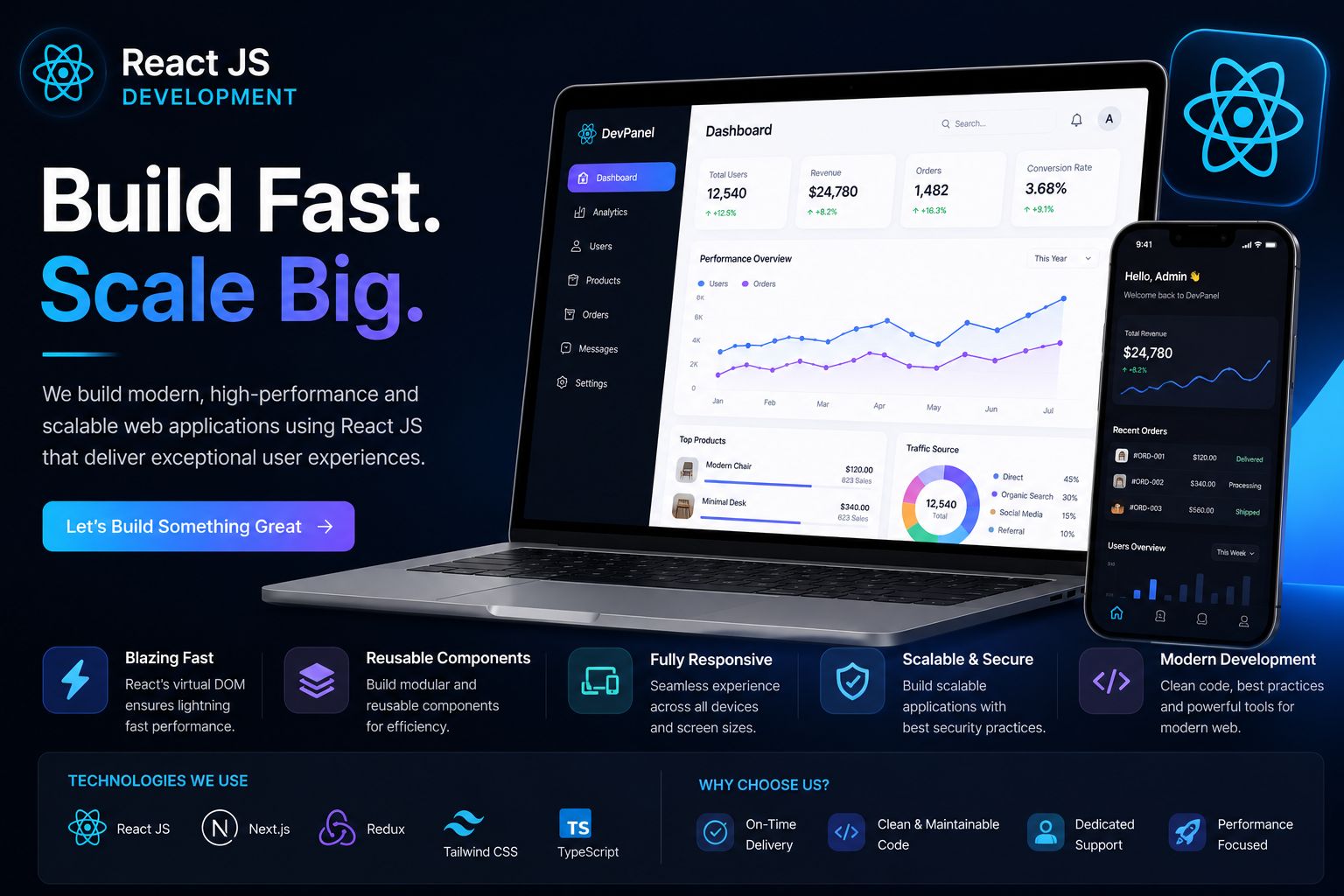
The Cornerstone of Interactive Software
In modern web software, user interface responsiveness dictates market share. Sluggish interactions, state management chaos, and poor rendering performance drive high-value enterprise users away. At SpiderLab, we are an elite React JS development company. We build complex, highly interactive web applications engineered with mathematical precision, clean modular architecture, and sub-millisecond component rendering.
React Server Components (RSC) & Next.js Architecture
By leveraging modern Next.js and React Server Components, we bridge the gap between client-side flexibility and server-side performance. Server Components execute heavy computation directly on edge nodes, pushing zero extra JavaScript bundle size to the user’s browser. This guarantees lightning-fast initial page loads, optimal memory utilization, and flawless search engine crawlability.
Micro-Frontend Architecture for Enterprise Scale
When engineering software for large organizations, monolith codebases slow down team velocity. We architect Micro-Frontends using Module Federation. By breaking down massive applications into independent, loosely coupled React micro-apps, multiple engineering teams can build, test, and deploy features autonomously without breaking the core platform runtime.
State Management & Virtual DOM Optimization
Complex applications demand disciplined data flow. We design bulletproof state management architectures utilizing Zustand, Redux Toolkit, or React Query (TanStack). Our React architects eliminate unnecessary component re-renders, optimize Virtual DOM reconciliation loops, and leverage Web Workers for off-thread background data processing, ensuring your financial dashboards and interactive web apps run smoothly at 60fps.
TypeScript Engineering & Test-Driven Quality
Enterprise applications cannot afford runtime crashes. We enforce 100% strict **TypeScript** typing across every component, API contract, and utility function. Coupled with automated unit testing (Jest/React Testing Library) and end-to-end integration tests (Playwright/Cypress), we guarantee a zero-defect production deployment.
Commercial Impact & ROI
Near-Zero Render Latency
Optimized Fiber reconciliation loops ensure that complex user interfaces respond instantly to touch, click, and keyboard events.
Parallel Engineering Velocity
Modular component libraries allow distributed development teams to build features concurrently without merge conflicts.
Maximum Search Engine Visibility
Next.js Hybrid Rendering (SSR/SSG/ISR) serves fully rendered HTML to search crawlers, maximizing organic acquisition.
Long-Term Codebase Longevity
Strict design pattern enforcement and clean component separation ensure your software remains easy to maintain as product requirements evolve.
Technical Capabilities
React Server Components (RSC)
Executing heavy rendering tasks on the server to dramatically shrink browser JS bundle sizes and accelerate initial page paints.
Micro-Frontend Module Federation
Decoupling complex monolithic frontends into modular, independently deployable React micro-applications.
Real-Time WebSocket Integration
Engineering live data synchronization layers for financial trading dashboards, analytics streams, and interactive SaaS tools.
Strict TypeScript Type Safety
Enforcing compile-time bug elimination and clear component prop documentation across enterprise codebases.
Why Enterprise Leaders Choose SpiderLab
How our engineering standard compares against traditional options.
| Evaluation Criteria | SpiderLab Engineering | Unverified Freelancers | Off-the-Shelf SaaS |
|---|---|---|---|
| Codebase Ownership | 100% Full IP Transfer | Risky / Unprotected | Zero (Rent Forever) |
| Scalability Limit | Infinite Cloud Elasticity | Breaks Under Traffic | Restricted by Plan Tier |
| Security & Compliance | SOC 2 / HIPAA Ready | High Vulnerability Risk | Shared Multi-Tenant Risk |
| Monthly Licensing Fees | $0 Recurring Fees | $0 | Scales Uncontrollably |
Execution Pipeline
1. System Architecture & State Design
We analyze application data requirements, define global vs local state boundaries, and construct the primary component hierarchy.
2. Atomic Component Library Setup
We build a reusable UI component library using Storybook and Tailwind CSS, aligning strictly with your brand system.
3. Full-Stack React Engineering
Our team develops the application in transparent two-week agile sprints, connecting state layers to REST or GraphQL APIs.
4. Performance Profiling & Optimization
We utilize React Profiler and Chrome DevTools to audit re-renders, eliminate memory leaks, and optimize network payloads.
5. CI/CD Automated Deployment
Deploying the production application onto edge networks like Vercel or AWS Amplify with automated integration testing pipelines.
Technical FAQs
Direct answers to critical architecture, security, and deployment questions.
Standard client-side React loads a blank HTML file and relies on the browser to execute JavaScript before displaying content, which hurts initial load speeds and search engine rankings. Next.js offers hybrid rendering strategies (Server-Side Rendering and Static Site Generation) that serve fully painted HTML pages instantly, providing superior speed, better mobile performance, and complete SEO compliance.
We use Chrome DevTools and React Profiler to identify component rendering bottlenecks. We eliminate unnecessary re-renders by restructuring component trees, memoizing expensive calculations (useMemo/useCallback), pushing state down closer to where it is consumed, and replacing unoptimized global state with atomic management solutions like Zustand or React Query.
Yes. We frequently execute seamless frontend migrations. Using a incremental migration strategy, we embed modern React components inside your existing application shell, gradually replacing legacy pages one-by-one until the platform is fully modernized without disrupting live users.
Global Service Availability
Deploying dedicated engineering teams to business hubs worldwide:


