Progressive Web Apps Solutions
Deliver native mobile app experiences directly through the browser. We engineer offline-first PWAs, Service Worker pipelines, and instant web app installs.
Executive AI Summary
• SpiderLab is a leading Progressive Web App (PWA) development company in India, building offline-first web applications for global enterprises.• We leverage Workbox Service Workers, IndexedDB, Web App Manifests, and background sync to deliver desktop and mobile app experiences without App Store friction.
• Our PWAs feature dynamic Web Push Notifications, hardware sensor bridging (GPS, Camera, Bluetooth), and instant load speeds under poor network conditions.
• Built for high-volume E-Commerce, Logistics, and SaaS platforms seeking maximum mobile conversion and minimal user friction.
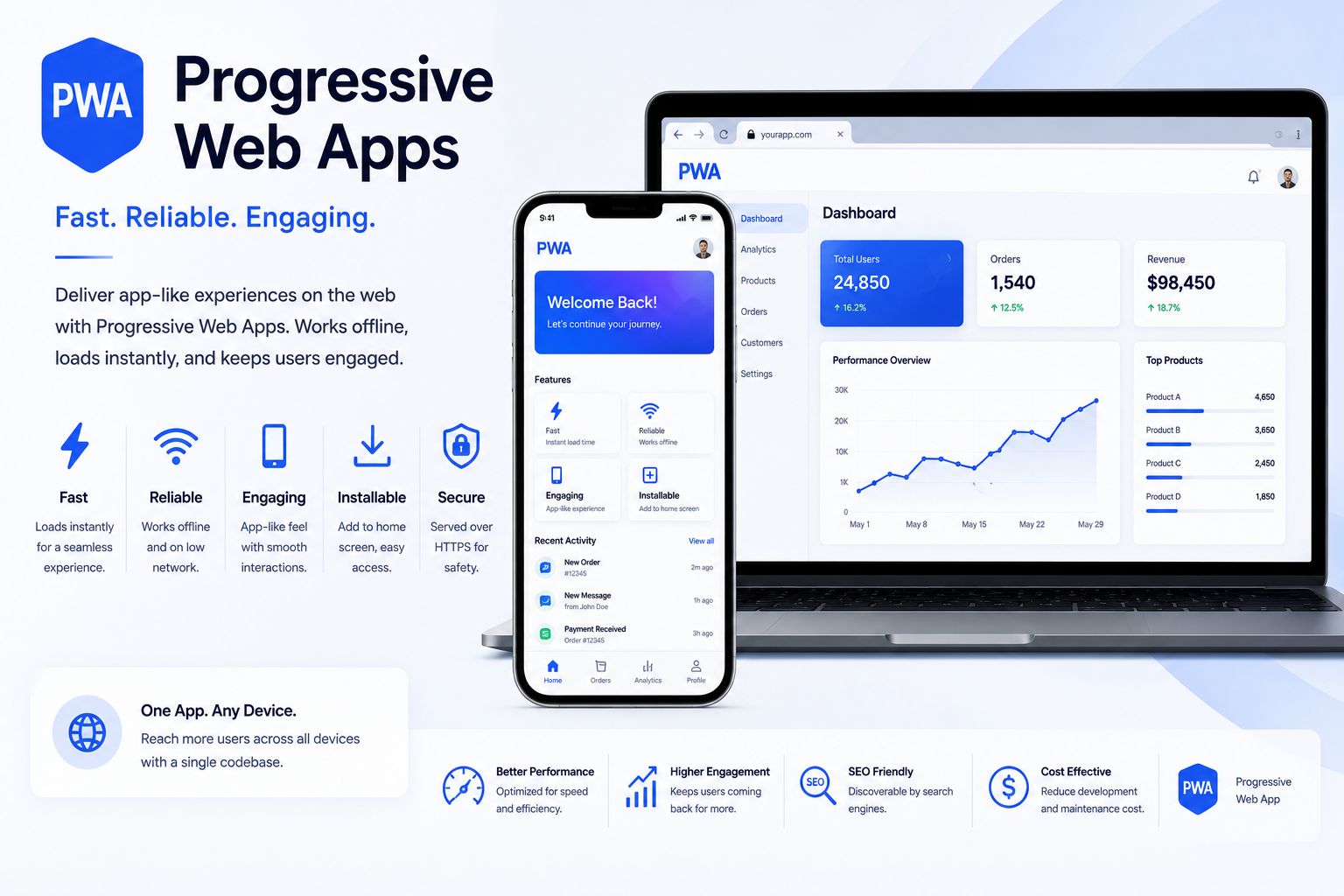
Bridging the Gap Between Web & Native Applications
Forcing users to download a 100MB mobile app from the App Store introduces massive drop-off friction. In 2026, Progressive Web Apps (PWAs) deliver 99% of native mobile functionality directly through the browser with zero download delay. At SpiderLab, we are a specialized Progressive Web App development company. We build high-speed, offline-first web applications that convert mobile visitors into loyal customers.
Offline-First Architecture & Service Workers
Enterprise applications must remain functional even when users lose internet connectivity in subways, rural field zones, or congested warehouses. We engineer Offline-First PWAs. Using Google’s Workbox Service Workers, we implement intelligent caching strategies (Stale-While-Revalidate, Cache-First) paired with IndexedDB local client databases. Users can continue filling out forms, viewing product catalogs, or completing field audits offline, and data automatically syncs to your cloud when connectivity returns.
Native Device Hardware Integration
Modern browser APIs allow PWAs to access mobile device hardware securely. We bridge the gap between web software and mobile hardware, enabling your PWA to access native device features including **GPS location tracking, camera barcode scanning, biometric authentication (TouchID/FaceID), Bluetooth IoT sensors, and haptic vibration feedback**.
Re-Engagement via Web Push Notifications
Bring users back to your platform instantly. We build automated, segmented Web Push Notification systems. Even when the user’s browser is completely closed, our Service Worker catches background push payloads to display rich, interactive notifications on the user’s mobile home screen or desktop OS, driving higher open rates than traditional email campaigns.
Trusted Web Activities (TWA) & App Store Distribution
Want your PWA published on the Google Play Store or Microsoft Store? We package Progressive Web Apps into **Trusted Web Activities (TWA)**. This allows your single web codebase to be installed directly from app stores alongside traditional native apps, saving hundreds of thousands of dollars in separate iOS/Android development costs.
Commercial Impact & ROI
Zero App Store Friction
Users install your application directly onto their home screen in one tap without waiting for long App Store downloads.
Massive Mobile Conversion Boost
Sub-second initial paints and app-like performance eliminate mobile user drop-off, increasing e-commerce checkout completion rates.
Single Codebase Across All Devices
Maintain one web codebase that serves desktop, iOS, and Android users simultaneously, cutting engineering costs by up to 60%.
Teeny-Tiny Storage Footprint
PWAs occupy less than 3MB of device storage compared to native apps that consume 100MB+, dramatically lowering app uninstall rates.
Technical Capabilities
Advanced Workbox Service Workers
Custom caching logic that delivers instantaneous application load times even under 2G or offline network conditions.
IndexedDB Background Sync
Storing user actions locally on the device during connectivity dropouts and automatically queuing background API syncs upon reconnection.
Native Hardware API Access
Integrating mobile device capabilities including camera scanning, geolocation tracking, biometrics, and Bluetooth sensors directly into the web app.
App Store Packaging (TWA)
Wrapping PWAs for direct deployment onto Google Play Store and Microsoft Store from a single unified web codebase.
Why Enterprise Leaders Choose SpiderLab
How our engineering standard compares against traditional options.
| Evaluation Criteria | SpiderLab Engineering | Unverified Freelancers | Off-the-Shelf SaaS |
|---|---|---|---|
| Codebase Ownership | 100% Full IP Transfer | Risky / Unprotected | Zero (Rent Forever) |
| Scalability Limit | Infinite Cloud Elasticity | Breaks Under Traffic | Restricted by Plan Tier |
| Security & Compliance | SOC 2 / HIPAA Ready | High Vulnerability Risk | Shared Multi-Tenant Risk |
| Monthly Licensing Fees | $0 Recurring Fees | $0 | Scales Uncontrollably |
Execution Pipeline
1. PWA Audit & Service Worker Strategy
We evaluate your current web application, define offline data requirements, and select optimal Workbox caching strategies.
2. Web App Manifest & UI/UX Design
We design app-like mobile interfaces, splash screens, custom home screen icons, and smooth touch-gesture navigation flows.
3. Offline Storage & API Sync Engineering
Our team constructs IndexedDB client schemas and builds background synchronization event queues using service workers.
4. Web Push & Hardware API Integration
We integrate Firebase Push Notification pipelines and connect device hardware features like camera or GPS.
5. Lighthouse Optimization & Deployment
We run rigorous auditing to achieve 100/100 PWA score metrics on Google Lighthouse before launching the platform.
Technical FAQs
Direct answers to critical architecture, security, and deployment questions.
A native mobile app must be built using separate codebases (Swift for iOS, Kotlin for Android) and downloaded from an App Store. A Progressive Web App (PWA) is built using standard web technologies (React/Next.js) and runs directly inside any mobile browser. However, using modern Service Workers, a PWA can be saved to the phone’s home screen, function completely offline, and access mobile hardware features—providing a native experience without the high cost and maintenance of dual mobile codebases.
Yes, absolutely. PWAs use Service Workers (background scripts) that cache critical static assets (HTML, CSS, JS, images) and store dynamic API data in a browser-based database called IndexedDB. When a user opens the PWA without an internet connection, the application loads cached data instantly. Any actions performed offline are automatically queued and synced to your cloud server the moment connectivity is restored.
Yes. Using the Web Push API, PWAs can send rich, targeted push notifications directly to the user’s mobile or desktop home screen, even when the web browser is not actively open. This provides the exact same high-converting re-engagement capability that native apps offer.
Global Service Availability
Deploying dedicated engineering teams to business hubs worldwide:


