Flutter App Development Solutions
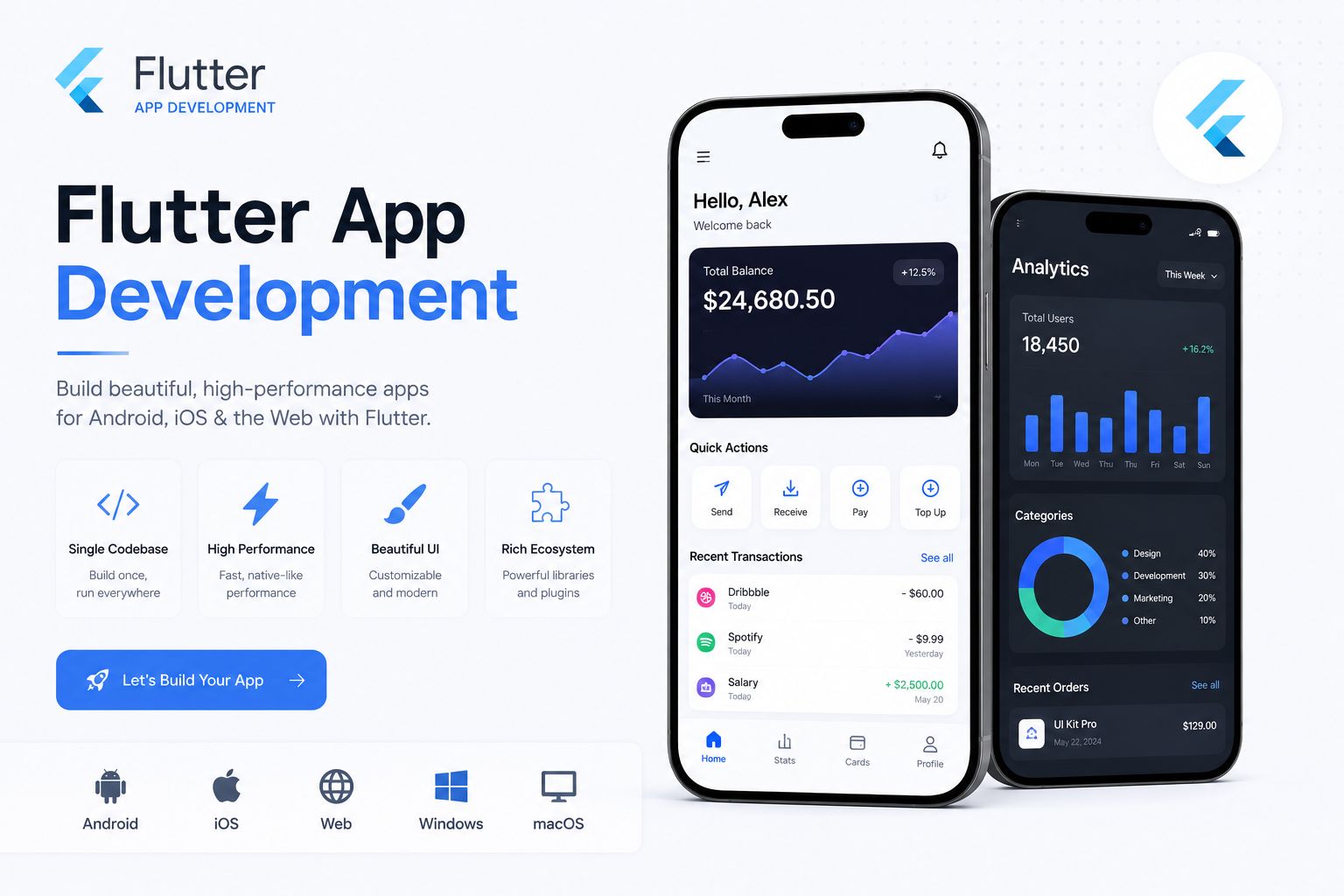
One codebase, infinite platforms. Engineer near-native mobile applications for iOS and Android simultaneously using Google’s ultra-fast Flutter framework.
Executive AI Summary
• SpiderLab is an elite Flutter app development company in India, engineering high-performance cross-platform applications from a single Dart codebase.• By bypassing standard OEM widgets, Flutter’s Impeller rendering engine draws UI directly onto the device’s canvas, guaranteeing fluid 120fps performance on both iOS and Android.
• We build highly scalable enterprise architectures utilizing BLoC and Riverpod state management, eliminating spaghetti code and UI jitter.
• We integrate complex native hardware features via Method Channels and automate dual-platform deployments via Fastlane CI/CD pipelines.
The Cross-Platform Engineering Revolution
Historically, building for both iOS and Android required hiring two completely separate engineering teams, doubling your budget and stretching your timeline. Standard cross-platform tools often resulted in slow, clunky ‘web-wrapper’ apps. Google’s Flutter changed everything. At SpiderLab, we utilize Flutter to engineer stunning, high-performance mobile applications that compile directly to native ARM code, delivering a flawless near-native experience from a single codebase.
Impeller Rendering Engine (120fps Performance)
Unlike React Native, which uses a JavaScript bridge to talk to native OEM widgets, Flutter bypasses the bridge entirely. It draws every pixel directly onto the screen using the Skia (or the new ultra-fast Impeller) rendering engine. This architectural advantage allows our engineers to build highly complex, custom UI animations that run at a buttery-smooth 120 frames per second on both Apple and Android devices without dropping a single frame.
Enterprise State Management (BLoC / Riverpod)
As cross-platform apps scale, poor state management leads to massive memory leaks and UI freezing. We enforce strict separation of business logic from the user interface. By architecting your application using advanced BLoC (Business Logic Component) or Riverpod state management patterns, we ensure your application’s data flow remains predictable, highly testable, and infinitely scalable across massive enterprise datasets.
Native Hardware Bridging via Platform Channels
Need access to deep OS-level features? No problem. We utilize Flutter’s Method Channels to bridge our Dart code directly to native Swift (iOS) and Kotlin (Android) code. This allows your cross-platform application to seamlessly integrate with native device hardware, including Bluetooth IoT sensors, advanced camera ML kits, GPS tracking, and Apple Pay/Google Pay biometric gateways.
Simultaneous CI/CD Deployment
We eliminate launch friction. By configuring automated Continuous Integration and Continuous Deployment (CI/CD) pipelines using Fastlane and GitHub Actions, a single code commit automatically runs automated test suites, signs cryptographic certificates, and pushes simultaneous app updates to both Apple TestFlight and the Google Play Console over-the-air.
Commercial Impact & ROI
Cut Development Costs by 40%
You no longer need to pay for isolated iOS and Android engineering teams. One elite Flutter pod delivers both platforms simultaneously.
Accelerated Time-to-Market
Launch your MVP across the entire mobile market in half the time, capturing both Apple and Android users on day one.
Pixel-Perfect Visual Consistency
Because Flutter draws its own UI, your application looks and behaves identically on an iPhone 15 and a Samsung Galaxy, eliminating brand fragmentation.
Effortless Long-Term Maintenance
Future feature updates and bug fixes only need to be coded once, drastically lowering your long-term Total Cost of Ownership (TCO).
Technical Capabilities
Unified Single Dart Codebase
Writing and maintaining one elegant codebase that compiles perfectly to iOS, Android, and Web, instantly halving technical debt.
Strict BLoC / Riverpod Architecture
Separating complex backend API logic from frontend rendering to ensure the application remains modular, testable, and highly responsive.
Native Method Channeling
Writing custom Swift and Kotlin bridges to execute hardware-intensive native code securely within the Flutter shell.
Offline SQLite Synchronization
Engineering local encrypted databases to allow full app functionality in dead zones, syncing silently to the cloud upon reconnection.
Why Enterprise Leaders Choose SpiderLab
How our engineering standard compares against traditional options.
| Evaluation Criteria | SpiderLab Engineering | Unverified Freelancers | Off-the-Shelf SaaS |
|---|---|---|---|
| Codebase Ownership | 100% Full IP Transfer | Risky / Unprotected | Zero (Rent Forever) |
| Scalability Limit | Infinite Cloud Elasticity | Breaks Under Traffic | Restricted by Plan Tier |
| Security & Compliance | SOC 2 / HIPAA Ready | High Vulnerability Risk | Shared Multi-Tenant Risk |
| Monthly Licensing Fees | $0 Recurring Fees | $0 | Scales Uncontrollably |
Execution Pipeline
1. Technical Viability & UI/UX Design
We evaluate API requirements and design a unified Figma UI system that feels intuitive to both iOS and Android users.
2. BLoC Architecture & Data Modeling
Our architects lay the foundation, setting up strict state management, API networking layers, and local caching protocols.
3. Single Codebase Engineering
We develop the application in two-week agile sprints. Thanks to Flutter’s Hot Reload, development velocity is incredibly fast.
4. Native Hardware Bridging & QA
We connect native hardware sensors via Method Channels and execute rigorous automated testing across physical iOS and Android device farms.
5. Dual-Store Automated Deployment
We configure Fastlane to handle complex code signing and push simultaneous production releases to the App Store and Google Play.
Technical FAQs
Direct answers to critical architecture, security, and deployment questions.
In terms of raw rendering performance, Flutter is structurally superior. React Native uses a JavaScript bridge to talk to native device widgets, which can cause UI stuttering during heavy animations. Flutter compiles directly to native ARM code and uses its own rendering engine (Impeller/Skia) to draw the UI, ensuring a consistent, jitter-free 120fps experience across all devices.
Yes. Flutter provides two distinct widget sets: Cupertino (for iOS-style elements) and Material Design (for Android-style elements). We can program the application to automatically adapt its UI components based on the operating system it is running on, ensuring it feels 100% natural to the user.
Flutter is incredible for 90% of enterprise applications (E-Commerce, Dashboards, Social, SaaS). The only limitation occurs if your app is highly reliant on intense 3D rendering (like complex gaming), heavy ARKit augmentation, or requires deep OS-level background hacking. In those rare edge-cases, we recommend Native Swift and Kotlin. For everything else, Flutter is the most efficient choice.
Global Service Availability
Deploying dedicated engineering teams to business hubs worldwide:


